
By Shari Peoples
The Great Depression is considered the worst economic crisis in American history. While there were numerous contributing factors to this devastating event, widespread panic among banking customers led to bank failures and played a vital role in the country’s descent from a recession into depression. As fear drove depositors to empty their accounts, an increasing number of banks were unable to meet customers’ immediate demands and were forced to close their doors, creating a domino effect across the nation. It was only after the federal government took measures to restore trust in the banking system that the path to recovery could begin.

After the stock market crash of 1929, the nation’s economy suffered major blows. In Lords of Finance, Ahmed discussed the immediate impact of the crash, noting that it was much worse on the United States than initially expected, causing decreased production and essentially doubling unemployment[1]. The inaction of the federal government resulted in the Federal Reserve lowering interest rates and flooding the economy with nearly half a million dollars.[2] Despite these efforts, industrial production in 1930 was down 30%, and unemployment had risen even more.[3] Throughout these changes, the banking systems were especially vulnerable.
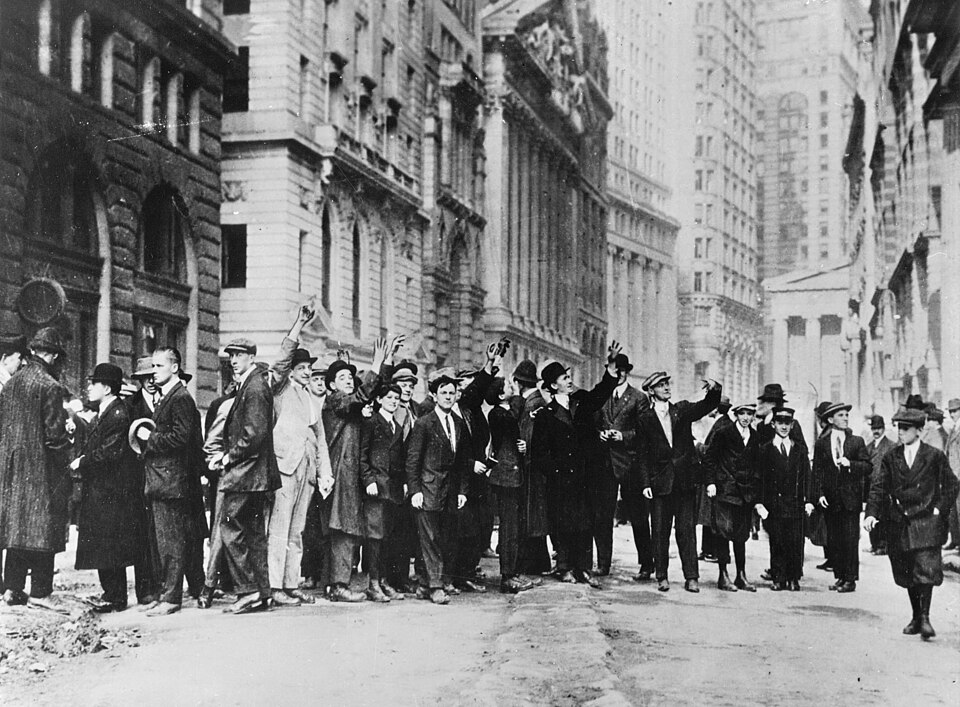
In the early twentieth century, the American banking system was not subject to the oversight and regulations that are now an elemental part of the industry, and there was no federal deposit insurance. Banks depended on the confidence of their customers to stay solvent. If customers panicked and tried to withdraw all their funds, it became a problem, as the bank did not keep the balance of deposits on hand. Gorton and Metrick explain the paradox of the bank run in “The Federal Reserve and Panic Prevention.” When customers demanded all their funds in cash, the bank did not have the cash on hand to give them. The Federal Reserve System was created to be a lender of last resort, but in the Great Depression era, they were not prepared to assist with bank runs that started in the later part of 1930.[4]
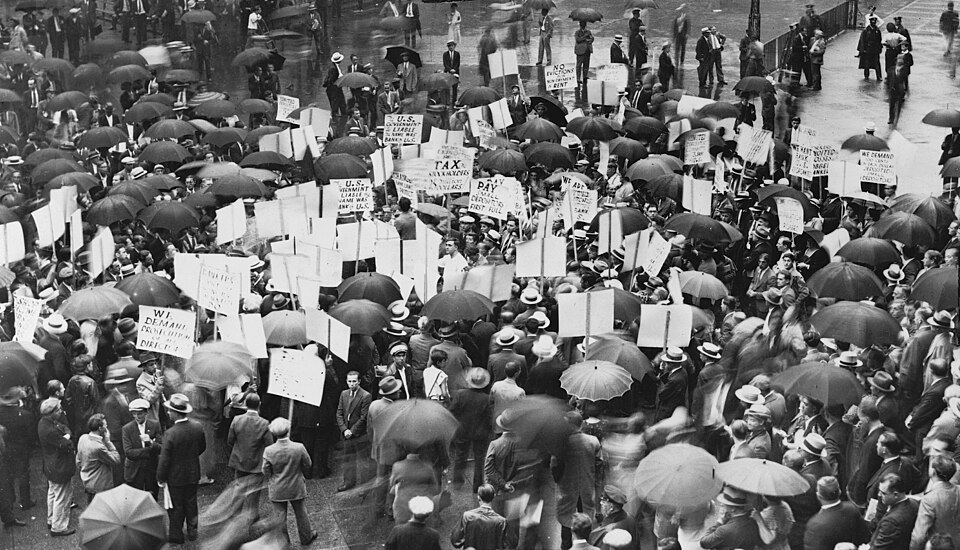
When the Bank of the United States in New York City faced requests from a man wanting to cash in his stock for the full purchase price, an unrealistic promise of the bank at the time of sale, it set off an unprecedented chain of events. There was a run on the bank that led to the creation of a mob, which had to be controlled by mounted police.[5] The New York Times remarked that the incident made it clear these enterprises needed to use “more scrupulous care and knowledge of its credit policy and practice.”[6] They called for banks to make at least half of a depositor’s funds available immediately.[7] Similar episodes of panic-driven runs on banks continued around the country, increasing drastically. The study by Calomiris and Mason on the Chicago banking panics illustrates how easily fear could get out of control and rapidly impact multiple institutions. The fear created a cycle in which panic became a driving force leading to additional bank failures.[8]
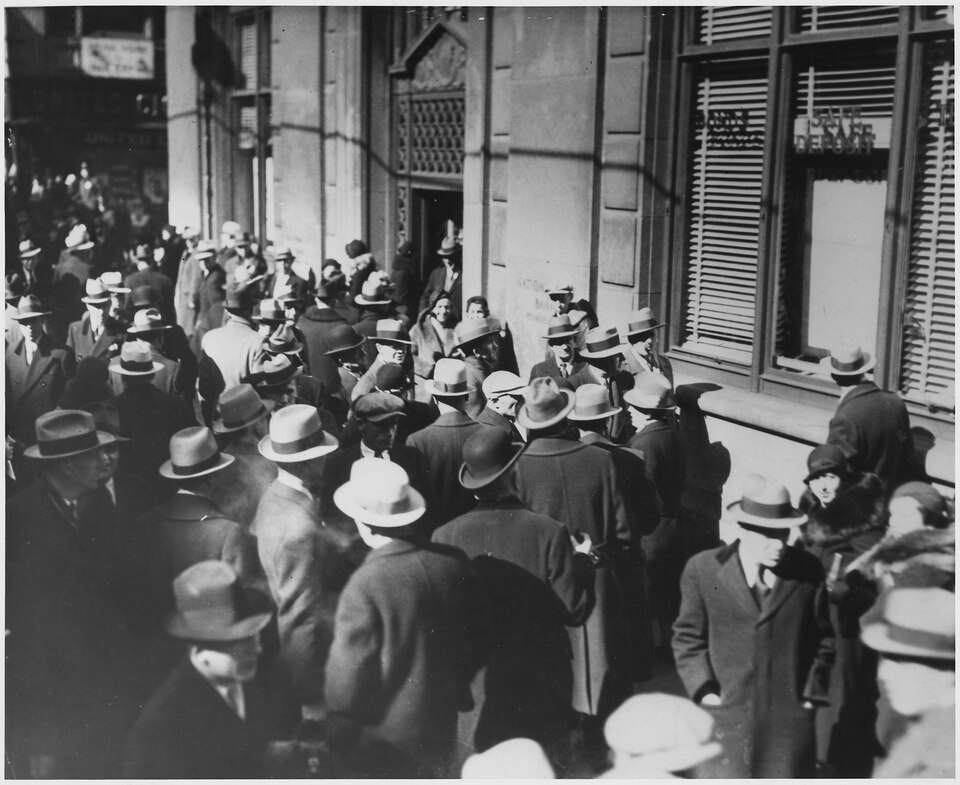
When examining the history, the question arises as to whether or not the bank runs and subsequent failures could have been avoided altogether. The panic and bank runs did not start when the stock market crashed in 1929 but rather when banks chose not to use the discount window afforded by the Federal Reserve as they needed it. Lack of action by the banks led the Federal Reserve to misread signals and assume that their intervention was not needed. When it became evident that the Federal Reserve was not going to bail out banks immediately through discount lending, President Hoover created the Reconstruction Finance Corporation in 1932, which began loaning money to banks early that year. At first the names of borrowing banks were withheld from the public, but once they were released, banks began looking elsewhere for funds, and customers demanded their money returned to their own pockets [9]
As the depression deepened, the federal government stepped in through a variety of ways to try and reign in the spiraling economy. One of the most impactful measures was the Banking Act of 1933, also known as the Glass -Steagall Act. This legislation aimed to separate commercial banking and investment banking. It also created the Federal Deposit Insurance Corporation, providing assurances for banks and their customers that their funds would have some amount of security in the banking system.[10] In 1935 an additional act was passed establishing a “Board-dominated Federal Open Market Committee” along with allowing greater lending power to the Federal Reserve in situations such as those presented by the Great Depression.[11] These acts were major moves toward restoring faith in the American banking system and setting the nation on a path of recovery.
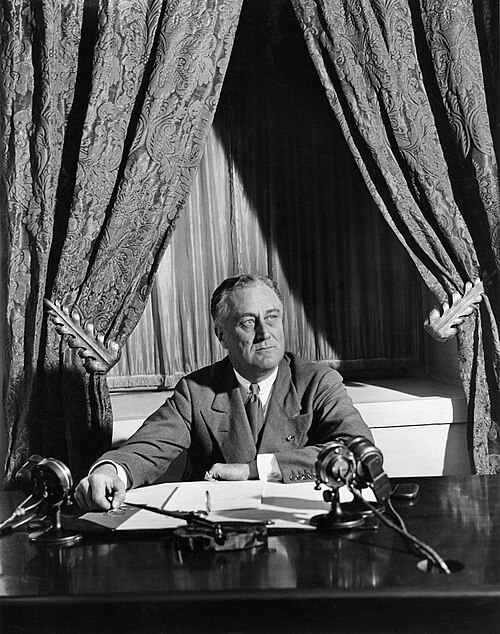
Additionally, President Franklin D. Roosevelt took steps to reassure the American people and bolster confidence with his fireside chats. On March 12, 1933, Roosevelt sat down and had the first of many “conversations” with the country in which he laid out in clear terms the conditions of the banking industry and the need for a banking holiday. His message called for all Americans to join him in “banishing fear. ” He told the country to “have faith” and not fall prey to “rumors or guesses,” laying the success or failure of his plan at the feet of the people.[12] His plea to the country was one of finding unity as a nation and working together to find a way through the problem. While this was not a quick fix or a miracle cure for the problems that faced the nation, in rebuilding the trust of the American people through banking legislation and communication, the country was able to begin its path to recovery.
[1] Ahamed, Liaquat. Lords of Finance : The Bankers Who Broke the World. (New York: Penguin Publishing Group, 2009, 319. accessed June 17, 2026. ProQuest Ebook Central.
[2] Ibid, 323.
[3] Ibid, 330.
[4] Gorton, Gary, and Andrew Metrick. “The Federal Reserve and Panic Prevention: The Roles of Financial Regulation and Lender of Last Resort.” The Journal of Economic Perspectives 27, no. 4 (2013): 47. http://www.jstor.org/stable/23560021.
[5] Ibid, 338-9.
[6] “The Bank Failure.” New York Times. December 13, 1930. https://www.nytimes.com/1930/12/13/archives/the-bank-failure.html.
[7] Ibid.
[8] Calomiris, Charles W, and Joseph Mason. 1997. “Contagion and Bank Failures during the Great Depression: The June 1932 Chicago Banking Panic.” American Economic Review 87 (5): 870–2. https://www.researchgate.net/publication/4901399_Contagion_and_Bank_Failures_During_the_Great_Depression_The_June_1932_Chicago_Banking_Panic.
[9] Ibid, 53-4.
[10] Banking Act of 1933, Pub. L. No. 73-66, 48 Stat. 162 (1933), accessed June 18, 2026, https://www.archives.gov.
[11] Calomiris and Mason, “Contagion and Bank Failures,” 55-6.
[12] Roosevelt, Franklin D. “Fireside Chat on Banking.” The American Presidency Project. March 12, 1933. https://www.presidency.ucsb.edu/documents/fireside-chat-banking.


Leave a Reply